22 Efficient electricity use
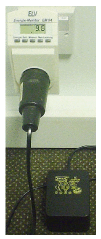
Figure 22.1. An awful AC lamp-adaptor from IKEA – the adaptor uses nearly 10 W even when the lamp is switched off!
Can we cut electricity use? Yes, switching off gadgets when they’re not in use is an easy way to make a difference. Energy-efficient light bulbs will save you electricity too.
We already examined gadgets in Chapter 11. Some gadgets are unimportant, but some are astonishing guzzlers. The laser-printer in my office, sitting there doing nothing, is slurping 17 W – nearly 0.5 kWh per day! A friend bought a lamp from IKEA. Its awful adaptor (figure 22.1) guzzles 10 W (0.25 kWh per day) whether or not the lamp is on. If you add up a few stereos, DVD players, cable modems, and wireless devices, you may even find that half of your home electricity consumption can be saved.
According to the International Energy Agency, standby power consumption accounts for roughly 8% of residential electricity demand. 1 In the UK and France, the average standby power is about 0.75 kWh/d per household. The problem isn’t standby itself – it’s the shoddy way in which standby is implemented. It’s perfectly possible to make standby systems that draw less than 0.01 W; but manufacturers, saving themselves a penny in the manufacturing costs, are saddling the consumer with an annual cost of pounds.
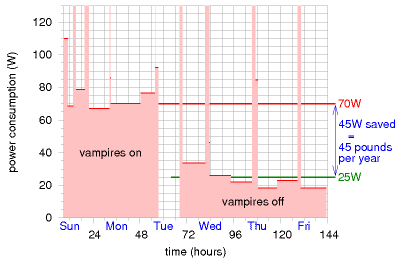
Figure 22.2. Efficiency in the offing. I measured the electricity savings from switching off vampires during a week when I was away at work most of each day, so both days and nights were almost devoid of useful activity, except for the fridge. The brief little blips of consumption are caused by the microwave, toaster, washing machine, or vacuum cleaner. On the Tuesday I switched off most of my vampires: two stereos, a DVD player, a cable modem, a wireless router, and an answering machine. The red line shows the trend of “nobody-at-home” consumption before, and the green line shows the “nobody-at-home” consumption after this change. Consumption fell by 45 W, or 1.1 kWh per day.
A vampire-killing experiment
Figure 22.2 shows an experiment I did at home. First, for two days, I measured the power consumption when I was out or asleep. Then, switching off all the gadgets that I normally left on, I measured again for three more days. I found that the power saved was 45 W – which is worth £45 per year if electricity costs 11p per unit.
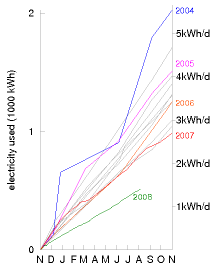
Figure 22.3. My cumulative domestic electricity consumption, in kWh, each year from 1993 to 2008. The grey lines show years from 1993 to 2003. (I haven’t labelled these with their years, to avoid clutter.) The coloured lines show the years 2004 onwards. The scale on the right shows the average rate of energy consumption, in kWh per day. The vampire experiment took place on 2nd October 2007. The combination of vampire-banishment with energy-saving-lightbulb installation reduced my electricity consumption from 4 kWh/d to 2 kWh/d.
Since I started paying attention to my meter readings, my total electricity consumption has halved (figure 22.3). I’ve cemented this saving in place by making a habit of reading my meters every week, so as to check that the electricity-sucking vampires have been banished. If this magic trick could be repeated in all homes and all workplaces, we could obviously make substantial savings. So a bunch of us in Cambridge are putting together a website devoted to making regular meter-reading fun and informative. The website, www.readyourmeter.org, aims to help people carry out similar experiments to mine, make sense of the resulting numbers, and get a warm fuzzy feeling from using less.
I do hope that this sort of smart-metering activity will make a difference. In the future cartoon-Britain of 2050, however, I’ve assumed that all such electricity savings are cancelled out by the miracle of growth. Growth is one of the tenets of our society: people are going to be wealthier, and thus able to play with more gadgets. The demand for ever-more-superlative computer games forces computers’ power consumption to increase. Last decade’s computers used to be thought pretty neat, but now they are found useless, and must be replaced by faster, hotter machines.
What happened to the vampires
A section added in the 2026 revision. This chapter has dated better than almost any other, because its recommendation was adopted almost immediately and then enforced by law.
MacKay’s complaint was precise: “the problem isn’t standby itself – it’s the shoddy way in which standby is implemented.” Within a year of the book appearing, the European Union made shoddy implementation illegal. Regulation (EC) 1275/2008 capped off-mode and standby power at 1 watt from 6 January 2010, or 2 watts for a device showing a display, and halved both limits to 0.5 and 1 watt from 6 January 2013. A later amendment extended the rules to networked standby, the state in which a device sits idle but connected. The replacement regulation, 2023/826, took effect on 9 May 2025 and tightens off mode to 0.3 watts from May 2027.2
Measure the examples in this chapter against that. The IKEA adaptor that drew 10 W could not legally be sold in the EU after 2010, and would be twenty times over the limit that applied from 2013. The office laser printer idling at 17 W is in a different equipment class, but the direction is the same. A device at the 0.5 W limit, left on permanently, consumes 0.012 kWh per day — against the 0.25 kWh/day MacKay measured from a single bad adaptor. The category he was writing about has largely been legislated out of existence, and the preparatory studies estimated the savings at about 35 TWh a year across the EU by 2020 from standby, and another 36 TWh from networked standby — together roughly a fifth of Sweden’s annual electricity consumption, obtained by regulating a design detail.
This is worth dwelling on, because it is the clearest case in the book of an argument of the “every BIG helps” kind actually working. The saving did not come from persuading millions of people to switch things off at the wall. It came from a rule that made the wasteful design illegal, applied once at the point of manufacture, and it then required nothing at all from the user. MacKay’s own experiment — reading his meters weekly and hunting vampires by hand — recovered 45 W. The regulation recovered a comparable amount in every household in Europe without anyone noticing.
One thing has not gone his way, and one has gone better than he expected. Lighting has been transformed twice over: the compact fluorescent bulbs he was recommending have themselves been superseded by LEDs, which do the same job again at roughly half the power and last far longer. Against that, the gadget category has grown in ways he did not anticipate — his 2008 house had no smart speakers, no broadband router running a mesh, and no home server — and networked standby is precisely the loophole the 2013 amendment had to be written to close.
And his closing assumption deserves testing, because he stated it plainly: “in the future cartoon-Britain of 2050, I’ve assumed that all such electricity savings are cancelled out by the miracle of growth.” That has not happened in Britain. As chapter L sets out, British energy use per person has fallen by 44% since he wrote — from about 123 kWh per day to 69 — while the economy grew. Growth did not cancel efficiency. It is fair to add that some of that fall is production moving abroad rather than disappearing, which chapter L also quantifies, but even on a consumption basis the decline is real. On this point the book was too pessimistic, and it is a pleasure to record it.
Notes and further reading
Standby power consumption accounts for roughly 8% of residential electricity. Source: International Energy Agency (2001). For further reading on standby-power policies, see: www.iea.org/textbase/subjectqueries/standby.asp.↩︎
Commission Regulation (EC) No 1275/2008 on ecodesign requirements for standby and off mode, as amended by Regulation (EU) No 801/2013 for networked standby, and replaced by Regulation (EU) 2023/826 with effect from 9 May 2025. The savings estimates of 35 TWh/year for standby and 36 TWh/year for networked standby are from the Commission’s preparatory studies, the latter from the 2011 Lot 26 study.↩︎